
Malta's GDP growth moderates but remains robust, Central Bank reports
Real GDP growth moderated in Q1 2026 but stayed above the euro area average, driven by domestic demand. Labour market remains tight, inflation eases.
Growth in Malta’s economy is easing from the previous quarter's pace but remains well ahead of the euro area average, according to the Central Bank of Malta's latest Quarterly Review.
Real GDP expanded at a slower rate in the first three months of 2026 compared to the fourth quarter of 2025, driven primarily by domestic demand. The output surplus narrowed as potential output rose faster than actual GDP.
The Bank’s Business Conditions Index ticked higher, signalling that activity is still running above its long-run average. This matters for businesses planning investment or expansion in the current cycle.
The labour market continues to put pressure on employers. The activity rate improved year-on-year, while employment growth stayed stronger than in the euro area. The unemployment rate edged up slightly but remains very low by historical standards.
Vacancies remain elevated even after a quarterly decline, confirming that labour market conditions are tight. Companies across sectors are still competing for a limited pool of workers, which keeps upward pressure on wages.
Consumer price inflation is cooling. Annual HICP inflation stood at 2.3% in March 2026, down from 2.5% in December 2025. Underlying inflation, which strips out energy and food, rose marginally to 2.4%. Headline inflation remains below the euro area average, though the core measure sits slightly above it.
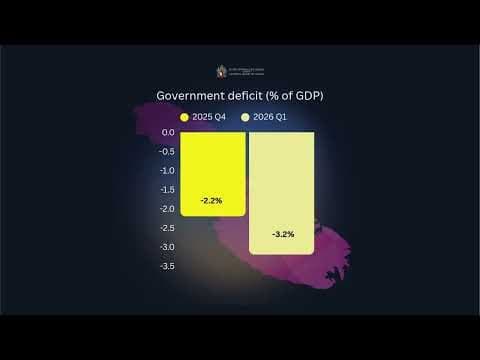
The government’s deficit widened in Q1 2026 compared to a year earlier. On a rolling four-quarter basis, the deficit-to-GDP ratio increased but remains in line with the euro area average. The debt-to-GDP ratio, however, fell and is well below the euro area benchmark.
The European Central Bank held its key interest rates steady during the first quarter. But in June, it raised rates by 25 basis points, citing the need to keep inflation anchored at the 2% target. The Governing Council described itself as well positioned to manage the uncertainty stemming from the war in the Middle East.
For Maltese businesses, the combination of moderating but still solid growth, a tight labour market, and renewed ECB tightening means the cost of hiring and borrowing is unlikely to ease soon. The Central Bank's full Quarterly Review is available online.