
Malta Employers warn labour migration model 'reaching its limits' as AI reshapes jobs
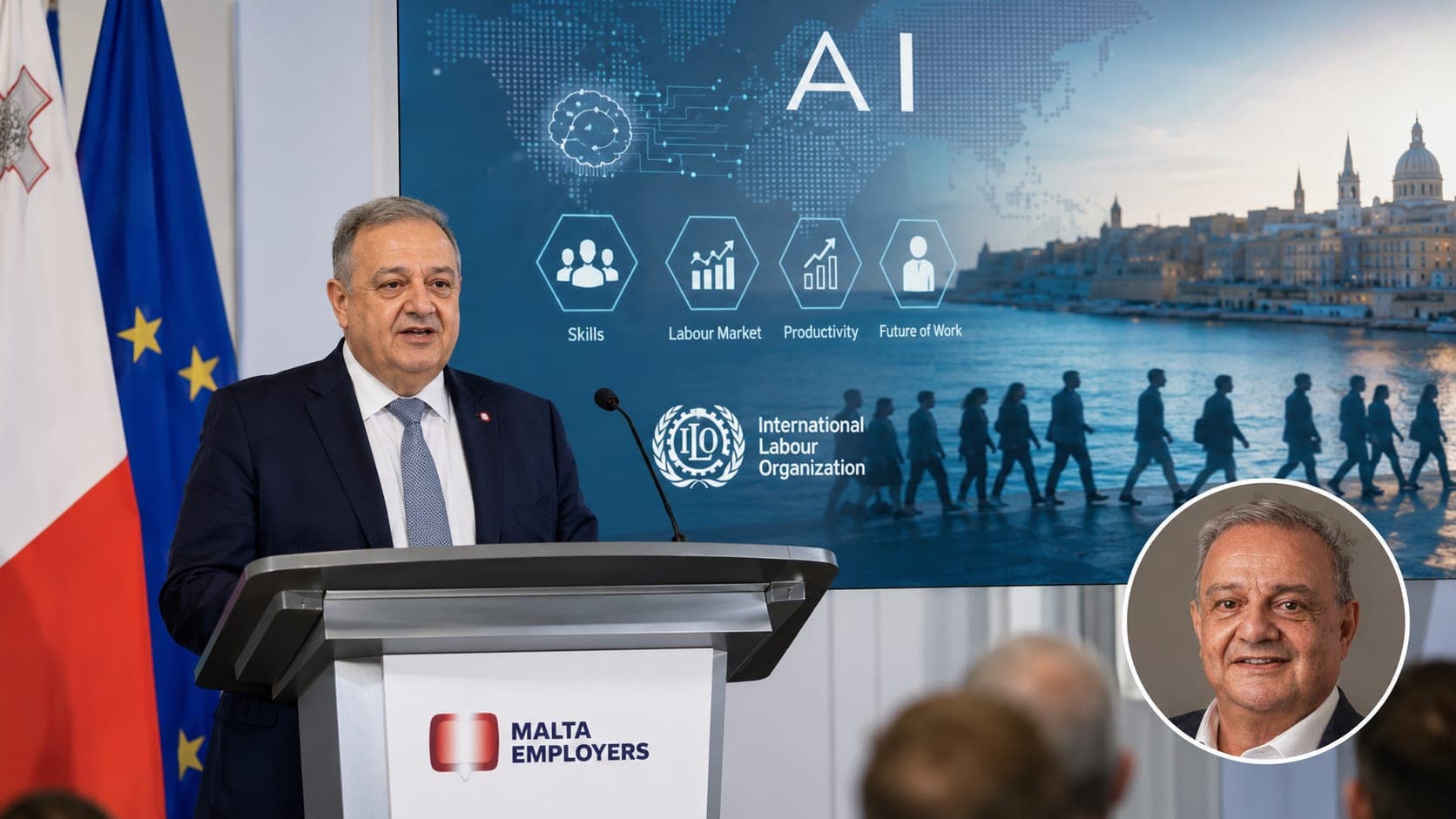
At the ILO conference, Malta Employers' delegate Ivan Refalo warned the labour migration model is unsustainable and called for an AI-ready workforce to avoid structural unemployment.
Ivan Refalo, the Malta Employers' delegate at the 114th International Labour Conference, told the gathering that the country's reliance on labour migration to fuel growth is fast reaching its limits. The model, he said, is not supported by the necessary infrastructure to sustain it.
Conflicts are at their highest level since World War Two, affecting some 2 billion people, with over 122 million persons displaced from their homes in 2025. The world of work cannot be isolated from this reality, Refalo noted.
Artificial intelligence is shaking the world of work even further. The ILO Director General's report reveals that 834 million jobs will be affected by AI, 135 million of them in Europe and Central Asia. The ILO estimates that 186 million people may remain jobless in 2026 due to the AI transition.
Refalo warned that the worst outcome would be structural unemployment, where vacancies and skills gaps exist alongside an increase in unemployment. He described AI adoption as a complex process of both job destruction and creation.
Malta has a small but highly diversified economy, with more than 95% of enterprises being SMEs. At 4% of GDP, Malta has one of the highest growth rates in the EU, driven by a strong entrepreneurial spirit in the private sector. But growth has been dependent on labour migration, and that model is reaching its limits.
Volume-based tourism is also reaching capacity, Refalo said. Maltese employers have been pushing for an economic transformation that steers the economy towards sectors that rely less on sheer numbers and more on higher value added activities.
Conditions of employment can only be improved with enhanced productivity. As things stand, many employees see the value of increased earnings eroded through higher property and rental prices.
With a dangerously low birth rate and a rapidly ageing labour force, employers insist on retaining the supply of working hours. Any measures that reduce working hours should focus on families with young children. Elderly employees need to be incentivised to extend their working lives rather than retire earlier.
Government should not be seen as a dominant competitor in the labour market, Refalo said. It should increase its efficiency to release labour to the private sector. Education reform is needed to bridge persistent skills mismatches, particularly in STEM, green technology, and digital fields. Preparing the workforce for AI is a core pillar of Malta Employers' strategy.
Good governance, through fostering institutional trust, fiscal responsibility, and transparent public procurement, is one of the pillars of economic growth. Maltese employers remain deeply committed to the ILO's principle of social dialogue.
True sustainability is achieved when employers, unions, and the government collaborate on long-term strategy rather than short-term political populism, Refalo said. The conference agenda also includes social dialogue and tripartism, the platform economy, and gender equality.